
Cover blurb
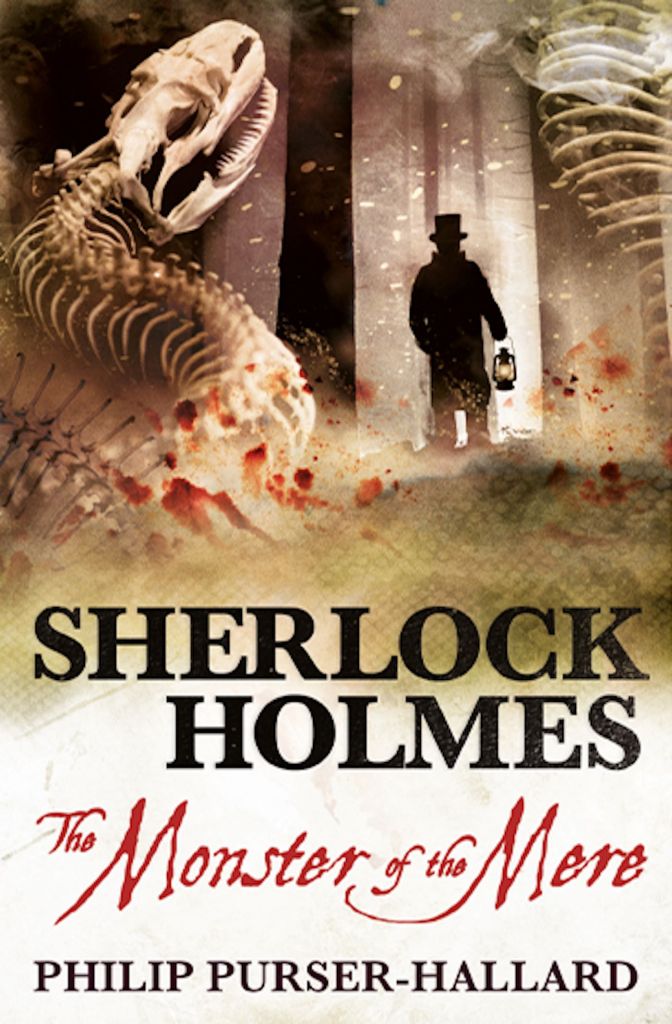
When Watson’s holiday in the Lake District takes a sinister twist, he and Holmes must uncover the truth hidden by superstitious locals, folklore, and rumours of prehistorical monsters far away from the familiar streets of London…
A serene walking holiday in the Lake District becomes a far more sinister excursion for Dr Watson when disappearances and murders start occurring in the small town of Wermeholt.
Local legends, rumours of large slithering reptiles and spooked palaeontologists have the denizens paranoid and terrified, so it is up to Watson and his inbound companion Sherlock Holmes to uncover the truth and discover what is really lurking in the lake…
My thoughts
Sherlock Holmes is the most famous creation of Scottish author Sir Arthur Conan Doyle, but his best-known work outside the Holmes stories involved dinosaurs. The Lost World, published in 1912, chronicled the adventures of an expedition to a remote plateau in South America where dinosaurs and cavemen lived side by side. The star of the novel, Professor Challenger, would later reappear in a small number of novels and short stories written by Doyle, but the character never achieved the same level of success that Holmes did. Later authors would bring the characters together, such as in Sherlock Holmes’s War of the Worlds by Manly W. Wellman and Wade Wellman, where the two teamed up to fight H.G. Wells’ invading Martians. Challenger never appears in Philip Purser-Hallard’s Holmes pastiche The Monster of the Mere, but another character from The Lost World, Professor Summerlee, plays a central role in the mystery.
The novel opens with Dr. Watson enjoying a well-deserved holiday in the English countryside. Holmes isn’t present, having remained in London because the sleepy nature of rural life doesn’t generate enough crime to keep his constantly churning mind occupied. Watson welcomes the quiet, at least until he stumbles upon a depilated village on the shores of a lake, the buildings decorated with serpent iconography and the locals making weird hand gestures when they think he isn’t looking. He also meets a small group of academics consisting of a folklorist, a paleontologist and his wife, two university students, and the famous botanist Edward Summerlee. The Monster of the Mere is set several years before the events of The Lost World, so Summerlee hasn’t accompanied Challenger to the lost world yet. But just like in that more famous work of fiction, Summerlee is ever the skeptic, clearly believing his companions are on a wild goose chase—although what they are chasing, he and the others refuse to say.
Watson’s curiosity is piqued but he has no interest in probing further while he is on vacation. However, his holiday plans are soon ruined by a murder, with the victim killed by what looks like the bite of a large animal. As the mysteries and bodies pile up, the doctor calls on the aid of the great detective to help solve a riddle that stretches into the countryside’s prehistoric past.
The Monster of the Mere is clearly inspired by the most famous Holmes story, The Hound of the Baskervilles. Like that novel, Purser-Hallard’s work involves a legendary monster, a family curse, and has Holmes absent for a large chunk of the story. But what elevates the novel above many Holmes pastiches is its well-written prose and dialogue. The central mystery isn’t simply a retread of Hound despite the similarities, with Purser-Hallard regularly sprinkling enough clues and twists throughout the story to keep readers engaged. Unfortunately, the solution to the mystery is rather wild and seems more in the spirit of Robert Downey Jr.’s Holmes movies than the original novels. It also doesn’t help that Holmes starts sounding like Agent Mulder from The X-Files about midway through the story, spouting the wildest of theories from the flimsiest of evidence.
Still, make no mistake: I enjoyed The Monster of the Mere, if more for the ride than the destination. It is a well-written novel with an intriguing premise that cleverly weaves elements from The Lost World into the Holmes canon. Holmes’ purists may object to some of the more far-fetched elements of the plot, but if you don’t mind that, I think you will have a good time.
Trivia
- Philip Purser-Hallard is a British writer who has authored several science fiction, fantasy, and mystery novels. Visit his website.
- Paleo-literate readers may object to Watson’s descriptions of what constitutes a dinosaur, but the author explains in the afterward that a Victorian-era layman like the doctor wouldn’t have known much about paleontology.
- One problem for authors wishing to incorporate elements from The Lost World into Holmes’s canon is—assuming the novel takes place in the year it was published—the great detective by then was an old man who had retired to pursue his passion for beekeeping. The Monster of the Mere gets around this by essentially functioning as a prequel.

 Prehistoric Pulp