
Cover blurb
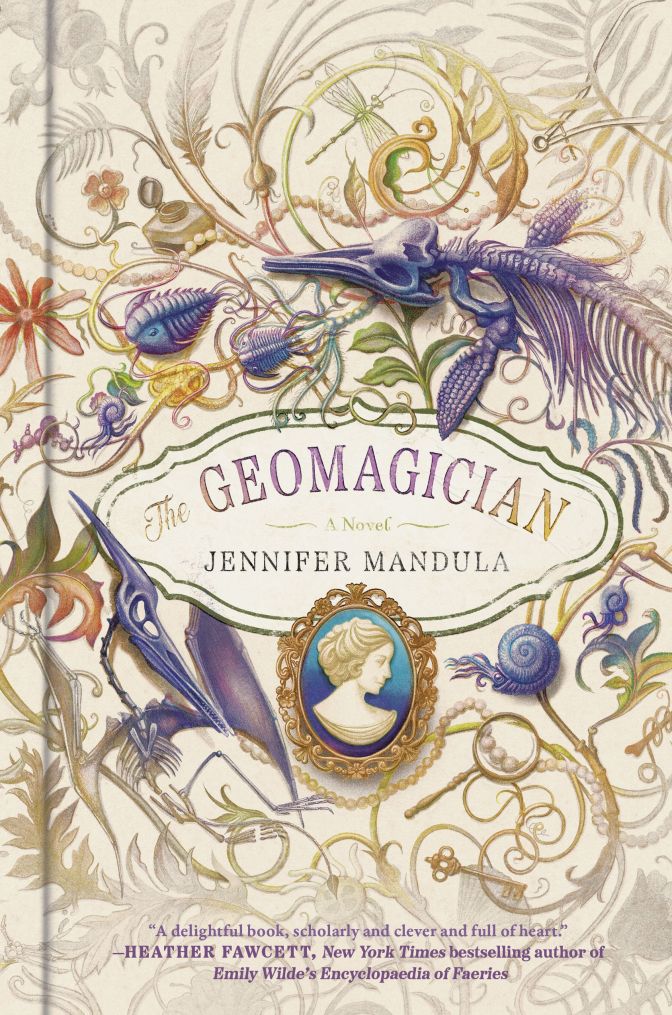
Mary Anning wants to be a geomagician — a paleontologist who uses fossils to wield magic — but since the Geomagical Society of London refuses to admit women, she’s stuck selling her discoveries to tourists instead. Then an ancient egg hatches in her hands, revealing a lovable baby pterodactyl that Mary names Ajax, and she knows that this is a scientific find that could make her career — if she’s strategic.
But when Mary contacts the Society about her discovery, they demand to take possession of Ajax. Their emissary is none other than Henry Stanton, a distinguished (and infuriatingly handsome) scholar . . . and the man who once broke Mary’s heart. She knows she can’t trust her fellow scholars, who want to discredit her and claim Ajax for their own, but Henry insists he believes in the brilliant Mary and only wants to help her obtain the respect she deserves.
Now Mary has a new mystery to solve that’s buried deeper than any dinosaur skeleton: She must uncover the secrets behind the Society and the truth about Henry. As her conscience begins to chafe against her ambition, Mary must decide what lengths she’s willing to go to finally belong — and what her heart really wants.
My thoughts
The 19th-century fossil hunter Mary Anning is one of the most important figures in early paleontology, although it wasn’t until much later that she received the fame she was due. While Anning wasn’t unknown in her time, her sex and low social status in stratified British society meant that she never received full credit for her discoveries. There have been relatively few works of fiction about Anning, with perhaps the best known and most controversial being the 2020 film Ammonite, which featured the fossil hunter in a lesbian relationship for which there is no evidence. The Geomagician by Jennifer Mandula also gives Anning a fictional love interest, along with magic powers.
The Geomagician is set in an alternate 19th century in which everyone radiates magical energy, but most people cannot generate enough energy at any given time to cast spells. However, humanity has learned that magical energy can be captured and stored in certain objects, called “reliqs.” A wide variety of materials can be used to create reliqs, although fossils work best. Anning collects fossils both for their scientific value and to sell as reliqs. Her greatest desire is to join the Geomagical Society of London, whose membership is closed to women. Then one day, following a landside, Anning discovers a fossilized egg from which a living pterodactyl chick hatches. She decides to use the pterodactyl as leverage to get the society to rewrite its rules to grant her membership. Unfortunately, that means Anning will need to work with Henry Stanton, a rich industrialist and naturalist who once sought her hand in marriage only to later disappear from her life.
The Geomagician is “romantasy,” so much of the focus is on the relationship between Anning and Stanton. The problem is that their relationship is the least interesting part of the narrative. It is a romantic conflict where if both parties simply took a little time to speak about the misunderstanding that drove them apart, the divide between them would be quickly bridged. And frankly, Stanton as a character is a bit of a bore, being a cliché romance novel love interest – rich, handsome, and willing to love a plain country gal for her brains alone. To be fair, his motivations remain murky until the very end, leaving the reader to constantly wonder if Anning would be better off without him.
Anning’s relationships with other characters in the novel are better written. As in real life, she is friends with naturalist William Buckland, who here serves as a mentor and father figure. Buckland clearly loves Anning as a daughter, but his upper-class status has blinded him to the struggles of the lower class, and his need to conform science to religion clashes with Anning’s instinct to seek naturalistic explanations for her discoveries. Then there is Anning’s best friend, the fictional Lucy Murray, who is one of the few people able to cast magic without the need of a reliq. Murray is also a political reformer who constantly tries to get Anning to acknowledge the unjust system they live under, but Anning fears that rocking the boat too much will end her chances of joining the society and becoming the first female geomagician.
The reader’s investment in Anning’s relationships will ultimately decide whether they end up finishing The Geomagician, as the novel is a slow burn. Most of the twists and revelations are saved for the very end, with the rest of the novel largely a deep dive into the fantasy society that Mandula has crafted. Readers do get an explanation early in the novel about how the pterodactyl came to be, but without going into spoilers, more could have been done with that element. While I enjoyed The Geomagician despite my lack of interest in the central romance, it has a pacing problem that may be hard for others to overlook.
Trivia
- The Geomagician offers an interesting spin on early paleontology. As in real life, the 19th-century naturalists of their world engage in heated debates over uniformitarianism vs. catastrophism and whether extinction is real. The catch is that in this alternate timeline, catastrophism may be the driving force of geology, and evolution may be driven by magic rather than natural selection. Yet magic appears to be a natural force rather than divine intervention, which puts geomagicians at odds with religious authorities despite the seemingly supernatural nature of spell casting.
- Henry Stanton is a fictional creation, but I suspect he is named after real-life American politician Henry Stanton, an abolitionist and social reformer.
- The Geomagican is the first of a planned two-novel series. No date has been set for the release of the second book, The Paleomancer.

 Prehistoric Pulp