
Cover blurb
The meteorite missed…
There was no great impact 66 million years ago, and the great reptiles of the Mesozoic lived on.
So begins a beguiling voyage of evolutionary discovery encompassing both geology and palaeontology, as scientist and father of speculative evolution, Dougal Dixon.
Dixon’s remarkable vision of the New Dinosaurs that could have evolved to live on in the world today is both awe inspiring and educational.
Learn about the dangerous Northclaws, track gargantuan flightless Trombles across bleak tundra, meet the cunning Springe of the swamps and marvel at the lightning-fast Sprintosaurs.
Dougal Dixon’s potent blend of up-to-date science and inventive fantasy, given life by superbly detailed colour illustrations, has produced a highly convincing alternative zoology – and a wonderful, modern array of New Dinosaurs.
My thoughts
The survival of non-avian dinosaurs into modern times has long been a popular trope in fiction, but one that was never approached with any scientific verisimilitude. By far the most well-known implementation of this plot device is the lost world, where a group of prehistoric animals from different time periods are shoved into a geographically isolated location, like an island or valley. Then in 1984, British sci-fi author Harry Harrison turned to another genre trope – alternate history – to imagine an Earth where the K-Pg extinction never took place, starting with West of Eden. But while Harrison went to great lengths to come up with an evolutionary history for the sentient reptiles of the series, he populated the rest of the world with prehistoric animals known from the fossil record, as if Mother Nature had hit the pause button on natural selection.
The New Dinosaurs by Scottish geologist and paleontologist Dougal Dixon is the first serious attempt to imagine a world where the non-avian dinosaurs survived. For me, the book has been something of a holy grail, as I previously had only been able to borrow copies from libraries yet never find a copy for myself at a reasonable price. Now the book has been republished by Breakdown Press for the first time since its original run. The new version isn’t the same as the original 1988 book. Dixon has updated the text in spots to reflect current science. He has also tweaked the ancestries of his imaginary animals to better align with our modern understanding of where the different dinosaur groups fit on the evolutionary tree. Most changes are fairly small, so I hesitate to call the reprinting a second edition of the book – it is more like a version 1.5.
The new backstory provided by the author is that in 1988, a scientific expedition was launched into an alternate world where the non-avian dinosaurs continued to evolve and thrive. The book is simply a glimpse into some of their discoveries, with Dixon saying the text has been updated to reflect the findings of a more recent expedition to the other Earth. After an introduction to what biological traits define a dinosaur, Dixon provides a “new tree of life” to show the evolutionary relationships of the “New Dinosaurs.” There is also a lengthy explanation of the planetary changes that have taken place in the past 66 million years, such as the rise of grasslands.
The bulk of the book consists of a bestiary of the different animals the expeditions encountered on their travels. Dixon avoids using modern names for the continents and instead divides the alternate world into zoogeographic realms based on the evolutionary relationships of the animals that live within each. For example, most of the African continent is the “Ethiopian Realm,” where the dinosaurs’ relatives – the pterosaurs – lost the ability to fly and became the dominant grazers of the savannas. There is the giraffe-like Lank, which uses vestigial fingers on its front legs to scratch itself. Then there are actual dinosaurs, like the tree-dwelling Waspeater, whose skull is specialized to raid wasp nests, or the Dwarf Titanosaurs of the offshore islands, which are one of the few New Dinosaurs to retain the appearance of the dinosaurs we know from the fossil record, except for their small size.
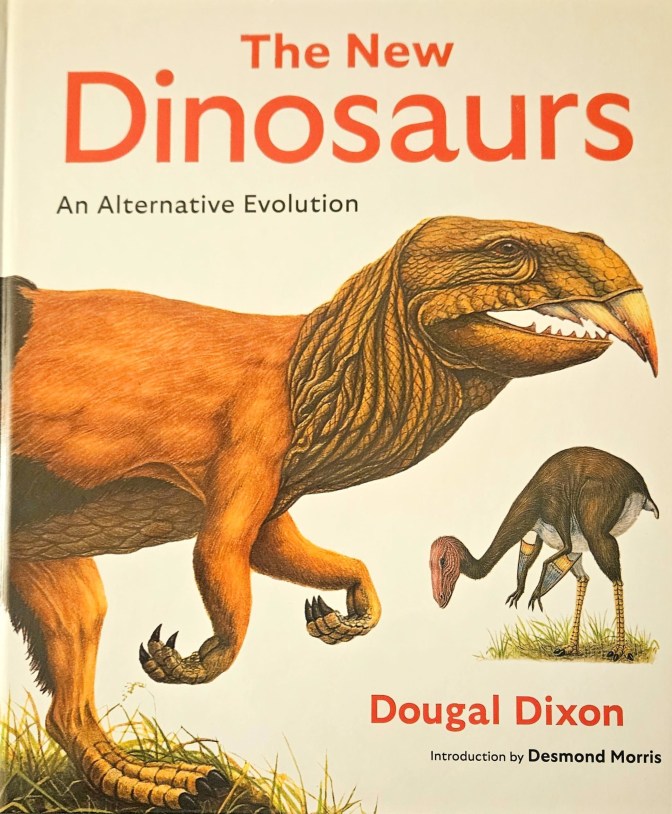
Each animal entry is accompanied by at least one illustration and a brief description of the animal’s biology and behavior. I don’t want to go into too much detail as half the fun of reading the book is encountering its strange wildlife for the first time, but I think knowledgeable readers will quickly pick up on Dixon’s inspirations. He leans heavily into convergent evolution, with many of the New Dinosaurs having analogs among living and extinct mammals. The creature that graces the cover – the Cutlasstooth – is clearly the dinosaurian equivalent of a sabretooth cat, complete with a color scheme that matches many paleoart interpretations of the animal. There are also dinosaur and pterosaur equivalents of sloths, elephants, musk oxen, kangaroos, whales and other real-world mammals, so the Earth of The New Dinosaurs feels very familiar despite having a different evolutionary history. The one exception is that there are no sentient dinosaurs, so readers hoping to encounter a “dinosauroid” will be disappointed.
I love The New Dinosaurs for its creativity and worldbuilding. I also appreciate Dixon for avoiding falling into the trap of making each of his animals big and scary to appeal to a popular audience. Most of the animals profiled are small and meek, and even the largest of the New Dinosaurs rarely approach the size of their ancestors. The tyrannosaurus are gone, along with most other large meat-eaters. The sauropods are confined to a few small corners of the globe, and the hadrosaurs have grown small and lithe to adapt to open grassland environments where the fastest usually survive. Dixon put a lot of thought into how dinosaurs would evolve to survive in the modern world rather than aim for what simply looked “cool.”
My main criticism of the book is the art. Even in 1988, I thought the illustrations failed to capture the dynamism of the animals. Several artists are credited, and I sympathize as they were commissioned to create animals with no counterparts in real world. But I don’t believe any of the artists had experience with paleoart as some of the illustrations are surprisingly regressive in dinosaur appearance. I vaguely remember one unkind review that stated that the “New” Dinosaurs had apparently evolved to resemble how artists depicted the animals in the early 20th century. The art is nowhere near that bad, but it is the book’s weakest element.
That complaint aside, The New Dinosaurs remains a classic of both paleofiction and speculative evolution. It is not a book with characters or a plot. Rather, it is a deep dive into a world that could have been if the asteroid had missed. If you’re willing to take the plunge, then I think you will enjoy it.
Trivia
- The New Dinosaurs was the second in a loose trilogy of speculative evolution books by Dixon. The first book was After Man, which depicts Earth 50 million years after humans have gone extinct. I highly recommend it. The third book was Man After Man, which posited the future evolutionary history of humanity. It was also the most controversial as Dixon turned to science fiction concepts such as genetic engineering and psychic powers rather than adhere to a strict evolutionary biology approach.
- If you have ever read the science fiction novel The Sparrow by Mary Doria Russell, then one of the New Dinosaurs may seem familiar as Russell credited Dixon’s book with inspiring her aliens. I won’t spoil it here as the animal’s identity would reveal the novel’s major plot twist, but once you read it and revisit The New Dinosaurs, you will recognize it. Click here if you want to know which animal.
- The New Dinosaurs concludes with a short essay on dinosaurs in fiction. That essay inspired me to start this blog – many, many years ago.
- In addition to being a scientist, Dixon is a prolific writer of popular nonfiction about paleontology and geology. His Wikipedia page credits him with having written more than 100 books, many of them for children.

 Prehistoric Pulp