
Cover blurb
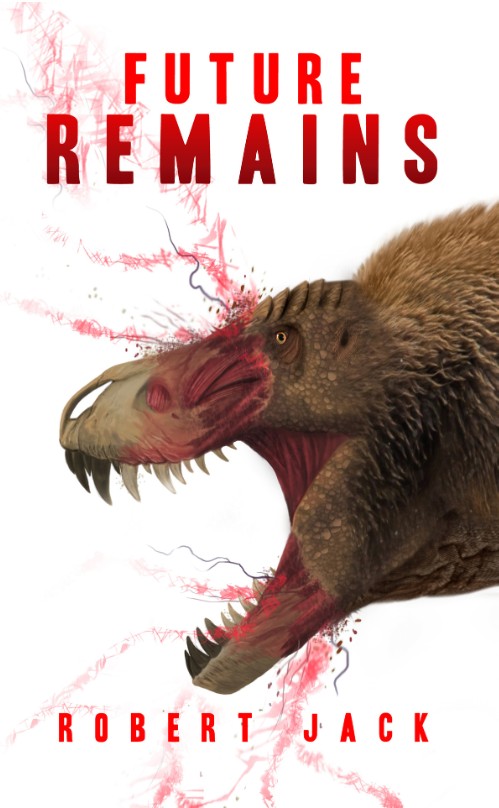
A small team of paleontologists has just laid eyes upon an impossible discovery. Now, at the behest of a mysterious stranger and his robotic companion, the team is being drawn into a desperate quest: to rescue a child trapped in the most dangerous environment the earth has ever seen.
For former paleontologist Tess Creegan, the stakes couldn’t be higher. Finding the boy will mean more than seeing a world ruled by dinosaurs – it could also be her chance to set right one of the greatest wrongs a mother could ever know.
My thoughts
Future Remains is a self-published novel by artist Robert Jack. I don’t know much about Jack other than that dinosaurs are his passion, judging by the gallery on his website. He also may or may not be a creationist, which makes a writing time travel adventure set in the late Cretaceous an odd choice, but more on that shortly.
The novel opens in the far future with the disappearance of a young boy, his robot, and a time machine that the boy’s father was building in a lab on the family property. The narrative then shifts to the modern day, where paleontologist Tess Creegan is convinced by her estranged husband, Ryan, to make a visit to a nearby dig. Tess has been in a deep depression since losing her young daughter in a car crash and is on the verge of giving up paleontology. However, her former colleagues have made an incredible discovery: An apparent time machine buried in Cretaceous-era strata.
Before the paleontologists can make sense of the finding, the machine’s creator, Erhardt Steiner, shows up and forcibly takes over the site. Erhandt explains that his son Emil took a joy ride in the machine but never returned. Erhandt wants to learn where and when Emil ended up, then rescue him. The characters eventually narrow down Emil’s location to the late Cretaceous, right before the K-Pg asteroid impact. They mount a rescue mission knowing that they must find the boy before the doomsday rock comes crashing down.
Future Remains is an old-fashioned science fiction novel in that it’s a simple adventure story that isn’t concerned about the science involved or has anything particularly deep to say. It is just a tale about a group of time travelers being chased by dinosaurs. Still, to be fair, there is a little more going on. Tess’s grief for her daughter leads her to secretly hatch a plan to use the time machine to prevent the death of her child. That arc is mirrored in Erhandt, who learns early on that his son died in the Cretaceous, but knows he can still save the boy thanks to time travel. Both narratives lead to a bittersweet climax that is the novel’s strongest element.
Unfortunately, the story is weakened by two significant problems. The first is the depiction of the late Cretaceous. The world the time travelers encounter is largely empty, and the few dinosaurs the characters encounter are the standard Jurassic Park fare: T. rexes and raptors. The second, much larger problem is confined to only a couple of pages, but it’s a whopper. We learn that the novel’s highly advanced future society has rejected evolution as bad science:
Ryan whistled. “I know you’re some sort of genius, mad-scientist, Doc Brown-type, but paleobiology is my area of expertise. No offense, but I think you’re out of your depth on this, okay?”
“I’m out of my depth?” Erhardt laughed. “It’s no wonder you think man is descended of apes. Look at you! You carry your blind faith around like a sharp stick, poking anyone who stands too close!”
For a beat, he could only stare at the man. He put his hands up and tried to speak slowly. “I didn’t come up with the science, okay? The fossil record is —”
“Woefully incomplete and doggedly misinterpreted! You don’t have any answers, young man. You barely understand the questions. The sooner you accept that, the sooner you can make some real headway in your field.”
At first, I thought the above passage was the author hinting that the future society wasn’t quite the technological utopia originally depicted. And maybe it is, but this rejection of evolution is never mentioned again or contradicted. Without further context, I can only assume this passage represents what the author actually believes. I know there are more forms of creationism than Young Earth Creationism, but it blows my mind that someone who thinks the fossil record is “doggedly misinterpreted” would set a novel in the late Cretaceous. It is like a conspiracy theorist who believes the moon landings were faked setting their novel on a lunar station.
Ironically, if it weren’t for that brief foray into creationism, Future Remains would otherwise be a forgettable novel. Not a bad one, and not necessarily a waste of your time, but a book whose details you will struggle to recall not long after you finish it. Some of the character beats are effective, but the author didn’t put much effort into fleshing out the Cretaceous setting, and he didn’t aim for anything more than the routine T. rex and raptor chase scenes of a thousand other dinosaur media properties. The book is a little bland as a result.
Trivia
- The author’s website is Apt22art.
Reviews
- None

 Prehistoric Pulp